The Standup is Dead. Long Live the Ledger.
The biggest waste in software may not be bad code. It may be explaining work that your tools already know happened.

We have all lived this version of the standup.
It's 9:02 AM. Someone asks, "What did you work on yesterday?" And the honest answer is that you don't entirely remember. You spent six hours in a deep agentic flow — shipped a feature, refactored a module, killed two bugs that had been lurking for weeks. But you weren't writing it down as you went. You were delegating macro-actions to Claude Code, reviewing diffs, steering the work. You were in it.
So you say something vague. "Worked on the auth module. Made some progress."
And the client, who is also on the call, gets a little quieter. Because "progress" is not a status update. "Progress" is the word people use when they don't actually know what's happening. You can hear the anxiety arrive in real time.
The standup was invented to synchronize humans who were writing code line by line. It was never designed for a world where one developer and an AI agent can ship four user stories before lunch. The meeting hasn't kept up with the work, and the gap between the two is where client trust quietly erodes.
The Standup Was a Workaround, Not a Solution
Let's be honest about what the daily standup actually was. It was never a great idea. It was a patch.
It existed to answer three questions: What did you do? What will you do? What's blocking you? Those are reasonable questions. The problem is the delivery mechanism. We answered them by gathering everyone in a room — or a Zoom grid — every single morning, because there was no other reliable way to get the information out of the one place it lived: a developer's head.
In a pre-AI workflow, the developer was the only source of truth. The board didn't update itself. The commits didn't summarize themselves. If you wanted to know the state of the work, you had to ask the person doing it, and the standup was the ritualized, recurring way to ask. It was a manual synchronization protocol for a system that had no automatic one.
It's the same dynamic as a client walking into the kitchen to ask if the steak is cooking. They're not being difficult. They just have no window into the work, so the only way to reduce their anxiety is to interrupt it. An open kitchen makes that walk unnecessary — you can see the fire and the movement from your table. The standup is the client walking into the kitchen. The question is whether you still need them to.
The Client Anxiety Gap
When velocity goes up, silence gets louder.
You'd think shipping faster would make clients calmer. The opposite is true. Faster work widens the gap between "last thing I heard" and "current state of reality," and clients fill that gap with worry.
In traditional development, a developer who goes quiet for four hours is probably stuck. Silence was a reasonable proxy for something is wrong. So clients learned to read it that way. But in an agentic workflow, a developer who goes quiet for four hours may have just shipped an entire feature. The signal inverted. Silence now often means the opposite of what it used to.
The client doesn't know that. They can't see your terminal. They just see the silence and apply the old interpretation.
It's 2 PM. The client hasn't heard from you since the 9 AM call. In their mind, that's five hours of nothing. In your terminal, it's five hours of commits. Same five hours, two completely different stories — and the client is living in the wrong one.
The instinct is to treat this as a client problem: they're too anxious, they need to relax, they don't understand the workflow. But the anxiety is a rational response to a real information gap. You don't close that gap with reassurance, and you certainly don't close it with more meetings. You close it by making the work visible as it happens.
Why Manual Ticket Updates Are the Wrong Answer
The obvious fix is "just update your tickets more often." It is also the worst possible answer.
Updating tickets manually means context-switching out of flow, and context-switching is the single most expensive thing a developer can do. You spend 45 minutes building a complex mental model of a race condition — the dependency tree, the schema, the logic flow — and a 30-second status update knocks the whole thing down. Then it's 15 minutes to rebuild it. You pay fifteen minutes of recovery for a thirty-second interruption, and a few of those a day means you've spent your best hours rebuilding state instead of building software. We've written about this Context Switching Tax before, and it's brutal even in a conventional workflow.
In an agentic workflow it's worse. You're not just holding a mental model of the code — you're actively orchestrating a fallible agent. You're watching its choices, catching the moments where the brilliant-PhD-student model suddenly does something a ten-year-old would do, steering it back on track. Interrupting that to write a status update is like a surgeon stopping mid-procedure to file a progress report. The cost isn't just your lost focus. It's everything the agent does unsupervised while you're typing.
So the right answer was never "update tickets faster." The right answer is "stop updating tickets manually entirely."
The Project Ledger Does the Standup's Job Better
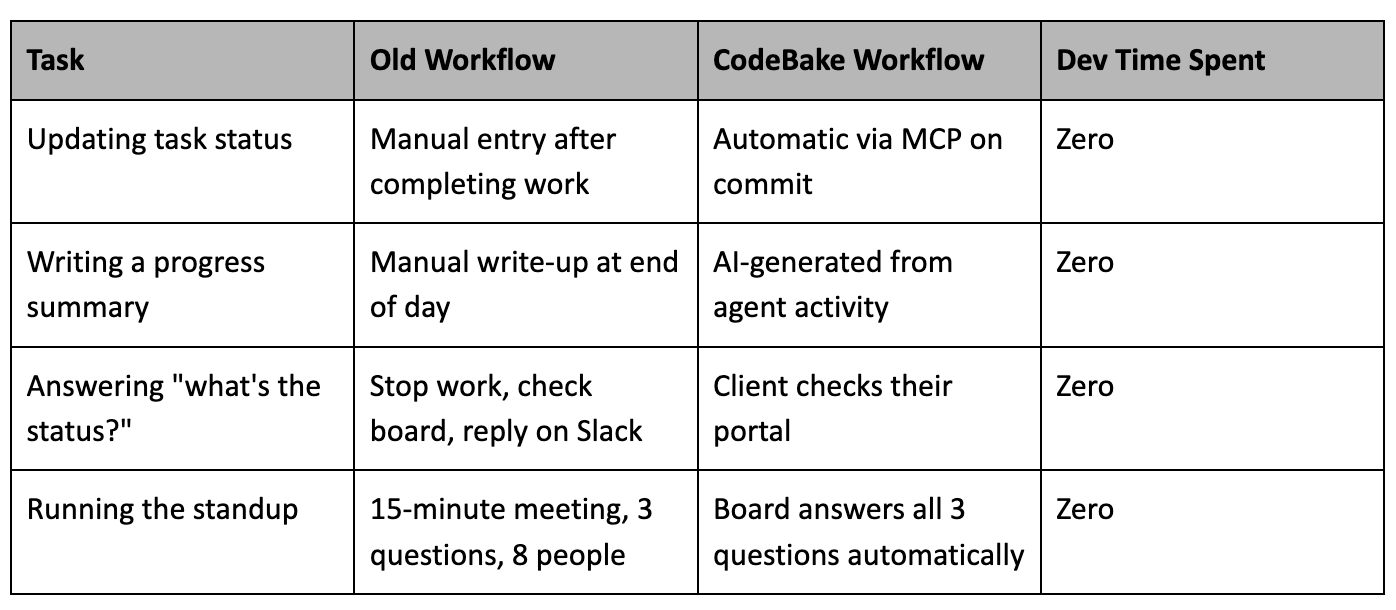
A self-updating Project Ledger doesn't just replace the standup. It does the standup's job better than any meeting ever could.
First, what we mean by a Project Ledger. Borrow the word from accounting, where a ledger is a running record of every transaction — entered in order, as it happens, and never quietly rewritten after the fact. A Project Ledger is the same idea applied to the work itself: every commit and pull request, every completed task, every file changed, every spec and PRD, every agent action — recorded chronologically as it occurs. The board you and the client look at is just a readable view onto that record. The Project Ledger is what's underneath — the source of truth the standup was always trying, and failing, to reconstruct from memory.
And memory is exactly the contrast. A standup is a snapshot of memory; a Project Ledger is a continuous record of truth. Memory is a terrible source of record — it's lossy, biased toward whatever happened most recently, and it quietly drops the two bugs you fixed at 11 AM because by the next morning they've blurred into "stuff I did." A Project Ledger doesn't blur.
Once the work records itself this way, you get a set of things a meeting could never give you. There's real accountability: every change traces back to a who, a when, and a why, instead of a hazy recollection of who said they'd handle the login bug. There's an accurate history. The PRs, the specs, the files touched, the PRD a decision came from, all preserved in the order they actually happened rather than reconstructed afterward. You can ask where the project stood two weeks ago and get a real answer, because the Project Ledger captures every point in time, not just the current one. That matters enormously the day something breaks and you need to know exactly what changed and when. And because all of it is already structured and current, a stakeholder report stops being a Friday-afternoon writing assignment and becomes a query: the work has documented itself, so the report is just the Project Ledger filtered for whoever's asking.
CodeBake connects directly to your AI tools through MCP, which means it listens to the work as the work occurs. Every commit, every completed task, every agent action flows into the board automatically. There's no write-up step, because the writing-down is the working. The record assembles itself as a byproduct of the actual job.
And the client gets a window, not a meeting. The client portal renders that Project Ledger as a clean, human-readable view — no jargon, no raw diffs, just a current and accurate picture of where things stand. They don't need you to stop and tell them. They can look. This is the open kitchen made real: the client sees the fire and the movement without ever walking in.
As Andrej Karpathy put it at Sequoia's AI Ascent this spring, the unit of programming shifted from typing lines of code to delegating larger macro actions — implement this feature, refactor this subsystem, run the tests and fix the failures. When the unit of work gets that big and that fast, a once-a-day verbal recap simply can't keep pace with it. The Project Ledger can, because it moves at the speed of the commits instead of the speed of the meeting.
What You Actually Need Meetings For
None of this is an argument against meetings. It's an argument for spending them on the things only a meeting can do.
Meetings are good at decisions. They're good at alignment. They're good at the human work of building a relationship with the person you're building for. What they're terrible at is status reconstruction, which is most of what a standup actually is.
When we started running our own client work this way, the meetings didn't disappear. They got shorter and a lot more focused. As Ben put it in Why We Built CodeBake, we talk about decisions that need to be made, not about reconstructing what happened last week. We stopped spending the first ten minutes rebuilding the previous week, because everyone had already seen it on the board.
That's the real shift. The standup's three questions — what did you do, what will you do, what's blocking you — should already be answered by the board before anyone joins the call. A meeting that opens with "everyone's read the board, so let's talk about the one decision we need to make" is a fundamentally different meeting than one that opens with "so… where are we?" One respects everyone's time. The other is a tax you pay because your tools couldn't keep up.
This is the larger turn the whole industry is making. As Nate B Jones wrote recently, execution keeps getting cheaper, and so the hard part is increasingly understanding what to build, why it matters, and how to use these tools well enough that they change your work. Status-chasing is not that hard part. It's the part we should have automated years ago, and now finally can.
The Bottom Line
The standup was a workaround for a broken information flow. It was the best tool available back when the project board couldn't update itself. That world is gone.
In an AI-accelerated workflow, the board can update itself. The work can document itself. The client can see what's happening without asking. The only thing standing between you and a standup-free week is a project management system that's actually connected to how you work.
CodeBake is that system.