
The Dev Shop Reckoning: How to Rebuild Your Business for the Age of Agentic AI
AI is compressing dev work and exposing true value: judgment, architecture, and accountability. Shops that adapt will win.

There's a conversation happening in dev shops right now, usually in private, often with some anxiety underneath it. It goes something like this: clients are starting to ask why things cost what they cost. Junior developers are shipping features that used to take seniors. Someone's nephew built a working MVP over a weekend. And a nagging question is forming that nobody quite wants to say out loud:
Is the way we've always done this about to stop working?
The honest answer is: the old model is under real pressure. But the shops that understand what's actually changing — not just that AI is faster, but what it's changing about the nature of the work — are going to come out of this in a stronger position than they went in. The disruption is real. So is the opportunity.
Here's how to think about it.
What Just Changed (And What Didn't)
If you've read my earlier piece on the five stages of AI capability, the short version is this: AI went from finishing lines of code to building entire greenfield applications in roughly two years. The pace of that progression is still accelerating.
What that means for a dev shop isn't that developers are obsolete. It's that the ratio of what humans do versus what AI does has shifted dramatically — and the nature of what remains human has changed.
The things AI is now genuinely good at: implementation, test coverage, boilerplate, refactoring, following a spec, maintaining consistency across a codebase. These used to be the billable core of most project work.
The things AI still gets wrong without human steering: understanding what a client actually needs versus what they asked for, making architectural decisions with long-term consequences, recognizing when a requirement will cause problems six months from now, knowing when to push back. These used to be the invisible value senior engineers provided on top of the billable work.
The disruption isn't that AI replaced developers. It's that AI made the invisible value visible — and made the parts you were billing for cheap.
The Three Shops
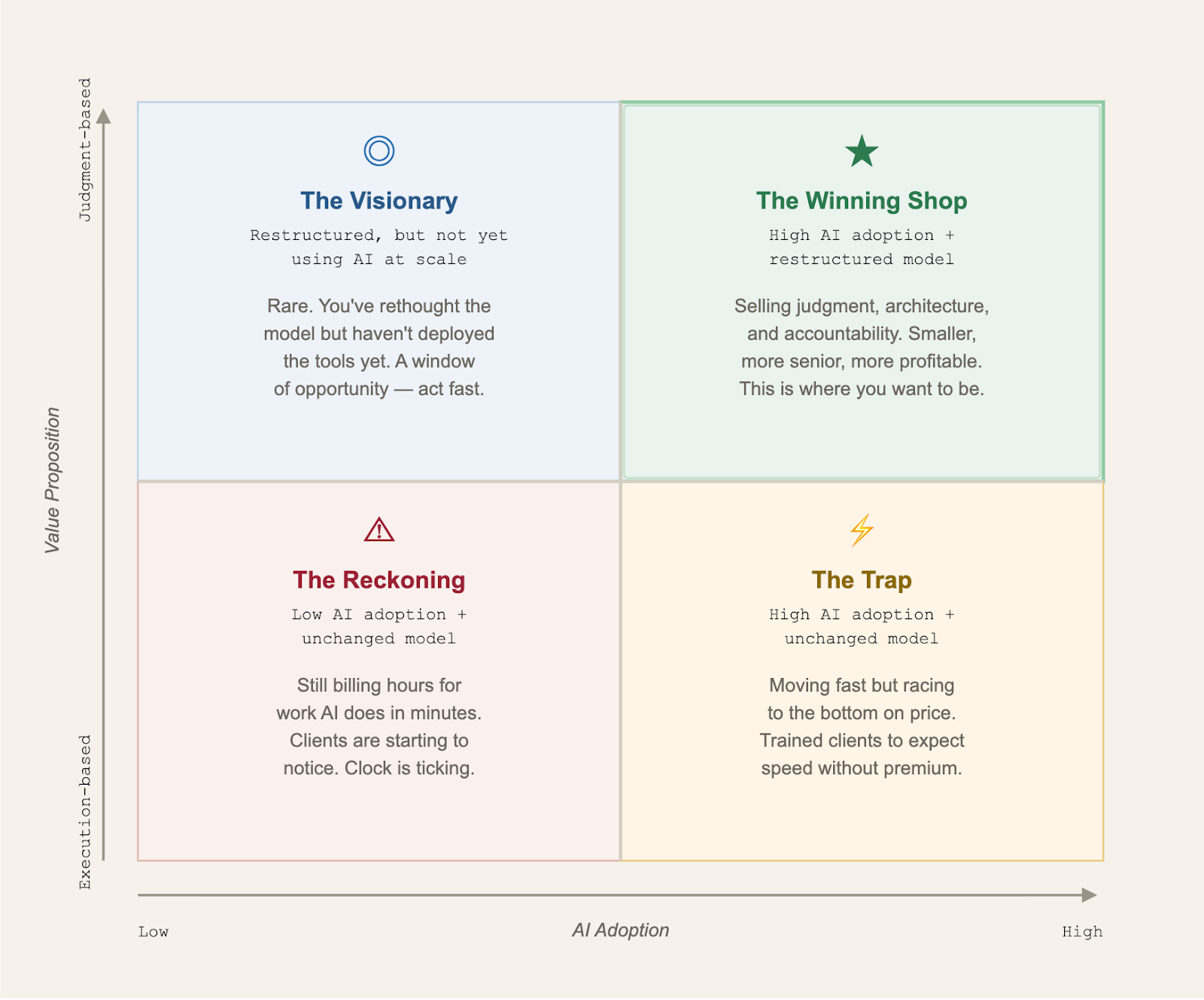
Dev shops are splitting into three groups right now, whether they realize it or not.
1. The shop that's pretending nothing has changed. Same team sizes, same hourly rates, same project timelines. Still winning work based on reputation and relationships, and it's still mostly working. But margins are quietly compressing — same work, same headcount, and clients are starting to sense that something doesn't add up. The Q1 2026 renewal cycle is already showing the cracks. By 2026/2027, the pressure will be impossible to ignore.
2. The shop that adopted AI but didn't change the model. Moving faster — but charging the same. Delivering in half the time looks like a windfall but is actually a trap. They've trained clients to expect that pace at that price. When a competitor shows up charging half as much and delivering in the same time, there's no margin left to defend on.
3. The shop that restructured around what AI actually changed. They've figured out that the product they're selling isn't hours of implementation — it's judgment, architecture, and accountability for outcomes. Smaller than they used to be, more senior-weighted, doing more work per person than ever before. Their clients are happier because the actual value they're getting — good decisions made on their behalf — is higher, not lower.
The shops in group three are winning. Getting there requires being honest about which parts of your current model are defensible and which aren't.
The Leverage Points
If you're restructuring for this new reality, there are three places where experienced dev shops have genuine, durable advantage over a client's nephew with a laptop and a Claude subscription.
- Architecture that survives contact with production. An AI agent will build you a clean, well-tested greenfield application. It will also, if left unsupervised, make a dozen architectural decisions that feel fine at the time and become expensive later — wrong abstractions, premature optimizations, data models that can't evolve, dependencies that create lock-in. Catching those decisions before they're baked in requires someone who has watched those mistakes play out before. That's not something you can vibe your way into. It's experience, and it's worth paying for.
- Client communication that doesn't require translation. Most clients don't know what they actually want until they see what they asked for. Managing that gap — understanding the business problem underneath the feature request, pushing back on requirements that will cause problems, setting realistic expectations about scope and timeline — is relationship and communication work. AI doesn't do this. Junior developers often can't do it well. Senior engineers at a good shop do it automatically, and its value to the client is enormous even when it's invisible.
- Accountability for outcomes. A solo developer with an AI agent has no one to answer to if things go wrong. A dev shop has reputation, contractual obligations, and institutional memory. Clients who are building something that matters — a product they're going to run, a system their business will depend on — need someone who will stand behind the work. That accountability has real value, and it's something only an organization can provide.
- Getting it across the finish line. AI is legendary at the first 80% of a feature, solid on the next 10%, and increasingly unreliable on the final 10% — the edge cases, the production-specific quirks, the integration that almost works, the error state nobody thought to spec. That last stretch is where demos become products and prototypes become liabilities. Clients often don't know this is where things fall apart until they're already in it. A good shop does — and knows how to navigate it.
The Visibility Problem (And Why It Compounds for Shops)
There's a structural problem with agentic AI development that hits dev shops harder than it hits solo developers: clients can't see what's happening.
When a senior engineer spent a week on a feature, there was a natural paper trail — commits, PR descriptions, standup updates, maybe a Loom walkthrough. Clients and project managers could follow along, ask questions, understand what they were paying for. That trail created trust.
Agentic work doesn't produce that trail naturally. An agent can build an entire feature in an afternoon, making dozens of architectural decisions along the way, and surface with a working result that tells nobody — including you — what happened or why. For a solo developer building their own product, that's manageable. For a dev shop billing a client, it's a trust and accountability problem. You're asking clients to pay for work they can't observe, from a process they don't understand, toward outcomes they can only evaluate after delivery.
This is the problem we built CodeBake to solve. The old model of project management — tickets, sprints, status updates written by hand — doesn't fit the new shape of the work. You can't just sync a fast-moving agent to a traditional issue tracker and expect it to make sense. What dev shops need instead is a complete replacement designed around agentic workflows from the ground up: a system that automatically logs agent decisions as they happen, gives project managers a live view of what's being built and why, and keeps clients genuinely informed without requiring a developer to stop and write a status report. Automated decision-logging instead of manual updates. A continuous audit trail instead of a weekly email.
The dev shops that figure out visibility first will have a significant advantage — not just operationally, but in how they sell.
"We build fast and you can see everything."
That's a compelling pitch in a market where the alternative is "we build fast and you have to trust us."
What the Team Looks Like Now
The math on team composition has changed. The old model — a senior or two leading a team of juniors doing implementation work — made sense when implementation was the bottleneck. It's not anymore.
The shops adapting well are leaning toward smaller, more senior-weighted teams. A principal-level engineer today functions less like a developer and more like an editor-in-chief — setting the architectural vision, directing agents, reviewing what they produce, and making the calls that determine whether the output is actually good. That role now has the leverage of what used to require three or four developers. The economics shift significantly: more projects, leaner teams, better outcomes.
What that doesn't mean is that juniors have no place. It means their role has shifted. The best use of a junior engineer in this environment isn't implementation — it's learning to develop taste and judgment quickly by watching how senior engineers steer AI outputs, reviewing what agents produce, and building the intuition for what good looks like. That's a more demanding apprenticeship than writing CRUD endpoints, but it's also a faster path to genuine expertise.
The Conversation to Have With Your Clients
If you're shifting your model, you need to be able to explain it to clients in a way that builds confidence rather than raising questions. The framing that works is simple: we've restructured around delivering better outcomes, not more hours.
Most clients don't actually want hours. They want working software, on time, that does what they need it to do and doesn't fall apart in six months. They pay for hours because that used to be the only way to measure progress. It doesn't have to be anymore.
The shops making this transition successfully are moving toward outcome-based or milestone-based pricing, being more explicit about what the human judgment component of their work is worth, and using visibility tools to let clients see progress continuously rather than waiting for a demo. That combination — clear outcomes, explicit value, real-time transparency — is a much stronger value proposition than "we're fast because we use AI too."
The Net of It
The dev shop model isn't dying. It's being filtered. The shops that survive the next two years will be the ones that figured out what they were actually selling — judgment, architecture, accountability, and the ability to cross the finish line — and restructured to deliver more of it, not less.
The tools have never been more powerful. The margin for coasting on implementation work has never been thinner. Those two things together create a specific kind of pressure that rewards the shops willing to be honest about what changed and adapt accordingly.
The reckoning is here. You can either wait for your clients to ask why they're still paying for hours — or you can show them exactly how your agentic workflow delivers more value than a freelancer with a prompt.
See how CodeBake brings visibility to the black box of agentic development →